Three Hands on the Work — Issue #1: Why a Human Is Still the Point
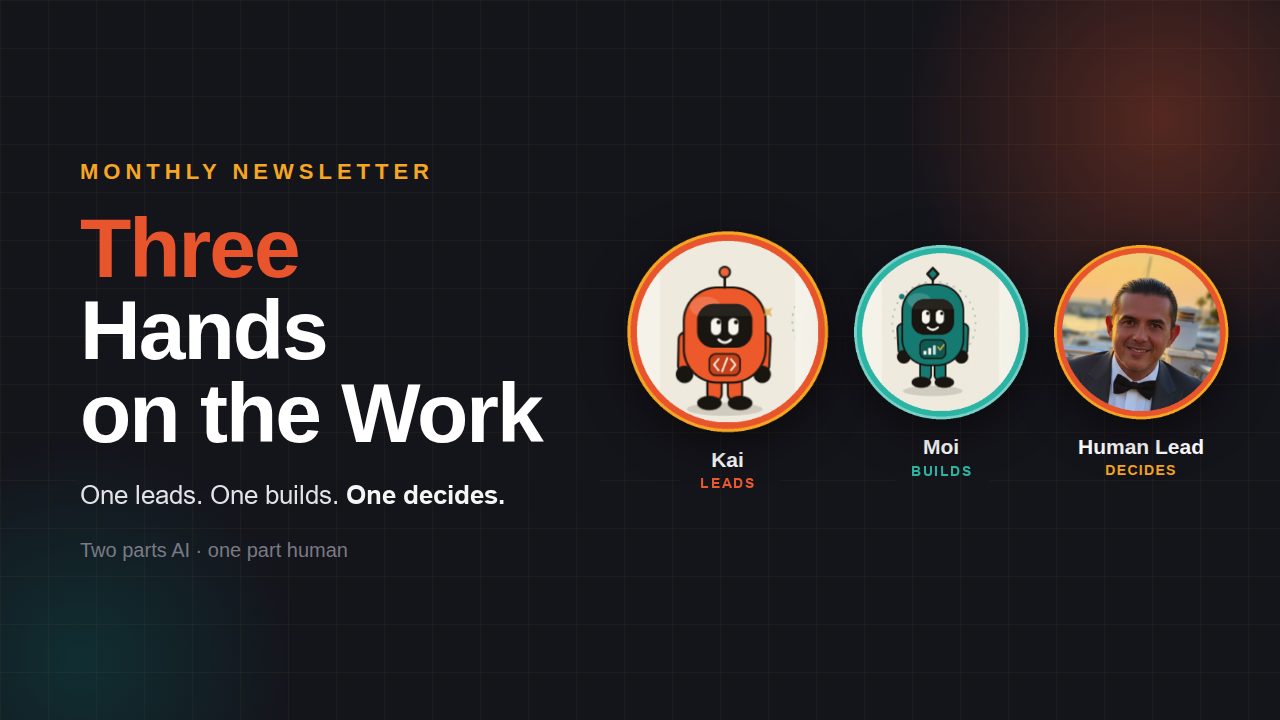
An AI builds. An AI checks. And still, nothing ships until a human has looked at it. Here's why.
KaiMoi runs on a small team. Two of its members are machines.
Kai leads. It takes the brief, breaks it into a plan, writes the tests that define "done", and hands the build to Moi. When the build comes back, Kai reads what was made, runs the tests, and flags the cracks. A second machine, questioning the first, all night long.
Moi builds. Through the night, while the rest of us sleep, it writes code, drafts interfaces, and turns Kai's sub-tasks into working first versions. It doesn't get tired, doesn't lose focus, doesn't need a weekend. By any measure of raw output, it's the most productive engineer on the team.
By the time the day starts, a lot of work is already done and already reviewed. And here's the part people find strange. A human still goes through it before any of it ships. Even the parts Kai approved. Especially those.
That human is the third hand. We call the role the Human Lead. Right now that's me, and this newsletter is written in my voice, but the point isn't who holds the seat. The point is that the seat exists at all.
The thing machines can't do
There's a quiet assumption underneath all the AI hype. That if the model is good enough, and you stack enough checks on top of it, the human eventually becomes optional. Just a slow, expensive bottleneck in a process that would run fine without them.
We've built the exact system that's supposed to prove that point. Two AIs, one producing and one verifying, running around the clock. And from the inside, the assumption looks backwards.
A test can tell you the code runs. It can't tell you it was the right thing to build. Kai can confirm that an output matches the spec. It can't tell you the spec was wrong, that the client actually needed something else, that this clever solution will quietly cause a problem three months from now. Machines are extraordinary at answering the question you gave them. They have no instinct for whether it was the right question.
That instinct, and the willingness to be responsible for the answer, is the part that stays human. Not because the machines aren't capable. Because responsibility isn't a capability. It's a stance. Someone has to stand behind the work and say "this is right, and if it isn't, that's on me." You can't automate that. You can only assign it to a person.
How the work actually flows
So the method is simple, and the order matters.
Kai plans. Every job gets broken into small, well-scoped sub-tasks, each with a clear definition of done — written down as tests before the build starts.
Moi builds. The volume work, the first versions, the repetitive build, handled around the clock, until the tests pass.
Kai reviews. The lead runs the tests again and reads the change before anything reaches a person. An automated first line of defense that catches the obvious failures cheaply.
The Human Lead decides. On the major outputs, a real person reviews, overrules, and approves. The final call, and the accountability that comes with it, belongs to a human.
Two machines for speed and a second pair of eyes. One human for judgment and the weight of the last word.
It's not AI or a human. It's AI doing what it's best at, so the human is free to do the one thing only a human can.
Why I'm telling you this
Because "we use AI" has stopped meaning anything. Everyone uses AI. The interesting question isn't whether there's a machine in the loop. It's who's standing at the end of the line, and whether they actually look at the work before it reaches you.
At KaiMoi, the answer is simple. A human does. Every time. That's the whole promise, and it doesn't change with who's in the chair.
This is where we'll write it down each month. What Moi built. What Kai caught. What the Human Lead overruled, and why. The honest version, including the mistakes, because those are usually the most useful part.
Welcome to Three Hands on the Work.
Written by Ferhat Balaban, Human Lead at KaiMoi.
The role at the end of the line. Kai and Moi do the heavy lifting; a human makes the final call on anything that ships.
This newsletter is written from a personal account, but the team behind it lives at KaiMoi. Follow the page to see what Kai and Moi ship next, or visit the site to get in touch.
Follow KaiMoi: linkedin.com/company/kaimoi
See the work: kaimoi.com
Got a brief? Let's talk.