The KaiMoi Philosophy: Trust Through Verification
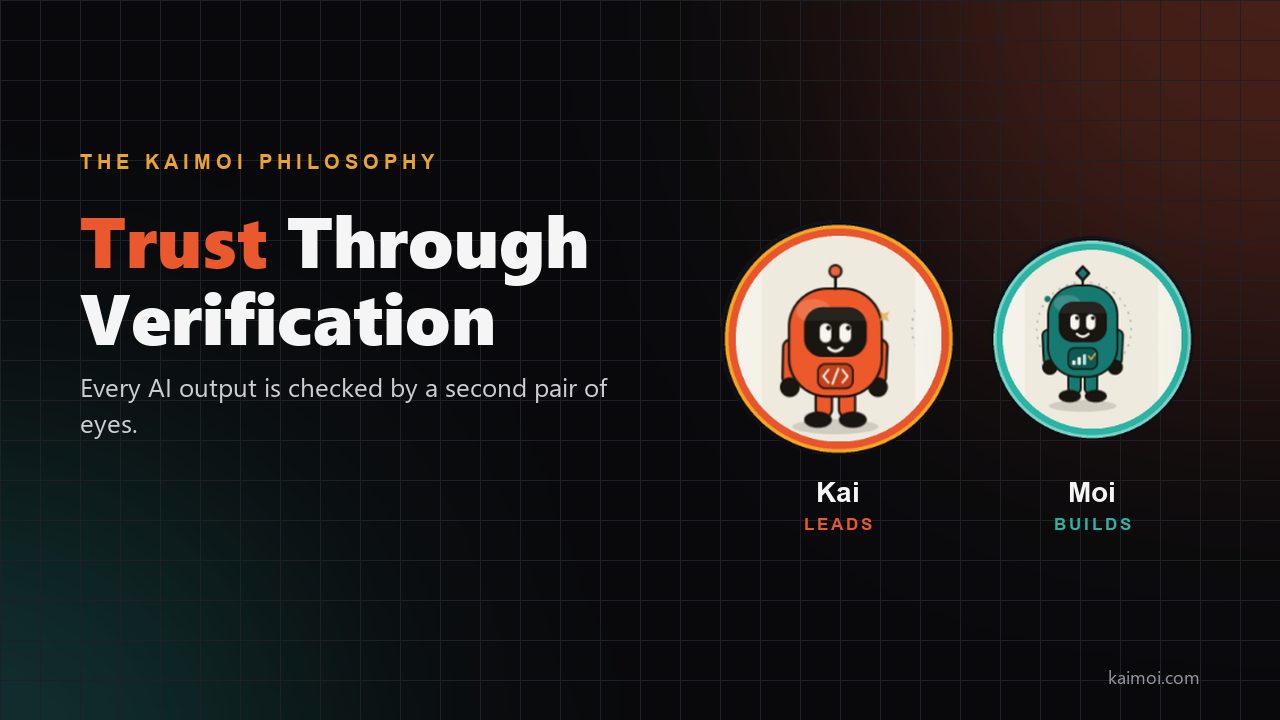
There is a quiet assumption embedded in almost every AI-assisted workflow: that if the model says it's correct, it probably is. We paste the output into our editor, skim for obvious errors, and move on. This assumption is understandable — these models are genuinely remarkable. But it is also, at scale, a liability. And KaiMoi was built on the explicit rejection of it.
The KaiMoi philosophy can be stated plainly: every AI output must be verified by a second AI before it reaches production. Not because the first AI is bad. Not because we distrust the model. But because this is what engineering discipline looks like when applied to AI — and engineering discipline is exactly what separates software that ships reliably from software that occasionally catches fire.
The Hallucination Problem Is Not Solved
Modern language models hallucinate. Not all the time — not even most of the time. But at a rate that matters when you're generating thousands of lines of code across hundreds of tasks. The hallucination isn't always dramatic. It's rarely "I made up an entire library." More often it's: calling a method that doesn't exist in this version of the framework, assuming a database column is nullable when it's not, or confidently writing logic that handles 90% of cases while silently failing on the tenth. These are the errors that survive casual review. These are the errors that reach production.
The conventional response to this is to make the model better. And models do keep getting better. But "better" is not "perfect," and the gap between those two words is precisely where bugs live. KaiMoi's response is different: don't try to eliminate the error at the source. Add a verification layer. This is not pessimism about AI — it's the same logic that drove the adoption of automated testing, continuous integration, and mandatory code review in human engineering teams.
What CI/CD Taught Us About Trust
Before continuous integration became standard practice, software teams relied heavily on developer self-review. A programmer would write a feature, test it locally, and push it to production. The results were predictably inconsistent. Not because the developers were incompetent — they weren't — but because self-review is structurally limited. The person who wrote the code carries the assumptions that produced it. They can't easily see what they took for granted.
CI/CD pipelines solved this by inserting an automated, assumption-free verification step between code and production. The pipeline doesn't care that you're confident. It runs the tests. It checks the linting. It builds the artifacts. It either passes or fails, and it does so without fatigue, without bias, and without the social awkwardness of telling a colleague their code is wrong.
Kai is that verification layer for AI output. Every change Moi produces — every edit, every commit, every file touched — goes through Kai's review before it reaches production. Kai reads the diff with fresh context, cross-references it against the project's conventions and schema, checks for logical gaps, and either approves the change or sends detailed feedback back with specific line numbers and actionable guidance. The loop runs until the change meets the bar.
Why Even Advanced AI Needs This
There's a tempting counter-argument here: isn't using a second AI to verify the first just compounding uncertainty? If Moi can hallucinate, can't Kai?
Yes. But two independent reasoning paths rarely hallucinate in the same direction. When Moi invents a method that doesn't exist, Kai approaches the same diff without Moi's generative context — with different training, different priors, and no stake in the output being correct. Kai is not trying to complete the task; it's evaluating whether the task was completed correctly. That difference in posture changes what gets caught. The reviewer notices what the author normalized.
More importantly, Kai's outputs are logged. Every review is written down in the task: accepted or sent back, with the reasoning and the test results. When a bug escapes — and occasionally one will — there is a trail. You can read the review. You can identify what the reviewer missed. You can update the review criteria. The system gets better not by hoping individual agents improve, but by systematically closing the gaps that escaped verification.
This is AI quality assurance as an engineering discipline, not as a feature. It's the difference between hoping your AI assistant is right and building a process that can demonstrate when it is.
Verification Is Not a Weakness
Some frame the need for AI verification as an admission of inadequacy — if the model were good enough, you wouldn't need a reviewer. This framing misunderstands what verification is for. Human surgeons operate in pairs not because either surgeon is incompetent but because redundancy catches what individual attention misses. Nuclear reactors run dual-channel safety systems not because the first channel is unreliable but because the cost of failure justifies the architecture.
The same logic applies here. Requiring AI accountability through peer review isn't a concession to AI's limitations. It's a recognition that high-stakes outputs — code that runs in production, changes that affect user data, deploys that go live — deserve a process that doesn't depend on any single point of judgment being perfect.
KaiMoi's pair AI architecture is that process. One agent builds. Another verifies. Together, they produce output that has been seen by two independent reasoning paths, logged, and approved. Not perfect — but auditable, improvable, and structurally more reliable than the alternative.
Every line of AI-generated code must be verified. KaiMoi proves that two AI agents — one builder, one reviewer — outperform any single model.