AI Pair Programming: Why Two Agents Beat One
Large language models are astonishingly capable programmers. Feed one a spec, and it spits out working code in seconds. But anyone who has used a single AI agent for serious work knows the dark side: hallucination. The model confidently invents API methods that don't exist, references files it never read, and silently drops edge cases. When there's no second pair of eyes, these errors slip into production.
The solution isn't a bigger model — it's a second model. Pair programming with two AI agents creates a self-correcting loop that catches errors before they land. This is the philosophy behind KaiMoi: two specialized AI agents that collaborate on every change, each doing what it does best.
The Single-Agent Hallucination Problem
When a lone AI agent writes code, it operates in a vacuum. It reads context, makes assumptions, and produces output. Without a reviewer, these assumptions go unchecked. The model might confidently call a function that doesn't exist, import a library the project doesn't use, or write logic that contradicts requirements stated three paragraphs earlier.
These aren't rare edge cases — they're the default failure mode of generative models. Every generated token carries a small probability of being subtly wrong, and in a complex feature, those probabilities compound. The result: code that looks correct but breaks in unexpected ways. Traditional development catches these through human code review. But human review is slow, inconsistent, and doesn't scale to AI-generated volume.
Why Two Agents Beat One
The core insight is simple: generation and verification are fundamentally different cognitive tasks. An AI that excels at creative code generation isn't necessarily good at catching its own mistakes — for the same reason that writers need editors. A second agent, optimized for critical analysis and verification, creates a check-and-balance dynamic that neither agent could achieve alone.
This dual-agent architecture mirrors the most effective human engineering practices:
- Builder mindset: Creative, fast, solution-oriented. Reads the spec, explores the codebase, and produces the implementation. Makes educated guesses when specifications are ambiguous.
- Reviewer mindset: Skeptical, detail-oriented, specification-driven. Reads the diff with fresh eyes, catches inconsistencies the builder missed, and ensures the fix actually addresses the root cause — not just the symptom.
The reviewer doesn't need to be smarter than the builder. It just needs a different perspective. This is the same reason pair programming works with humans: the navigator catches what the driver misses.
Real-World Impact
Consider a typical AI-assisted development scenario: a developer asks an AI to "add dark mode support." A single agent produces CSS variables, theme toggles, and component updates — but forgets the settings panel, leaves hardcoded colors in three utility files, and doesn't handle the transition between themes. The developer discovers these issues during manual testing, goes back to the AI, and iterates three more times. Total time: 45 minutes.
With a dual-agent setup, the builder produces the initial implementation, and the reviewer immediately flags: "Three files still reference hardcoded hex values. The settings persistence layer is missing. Color contrast ratios in dark mode don't meet WCAG AA." The builder fixes these before the developer even sees the output. Total time: one cycle. The difference compounds across dozens of changes per day.
The Philosophy: Trust Through Verification
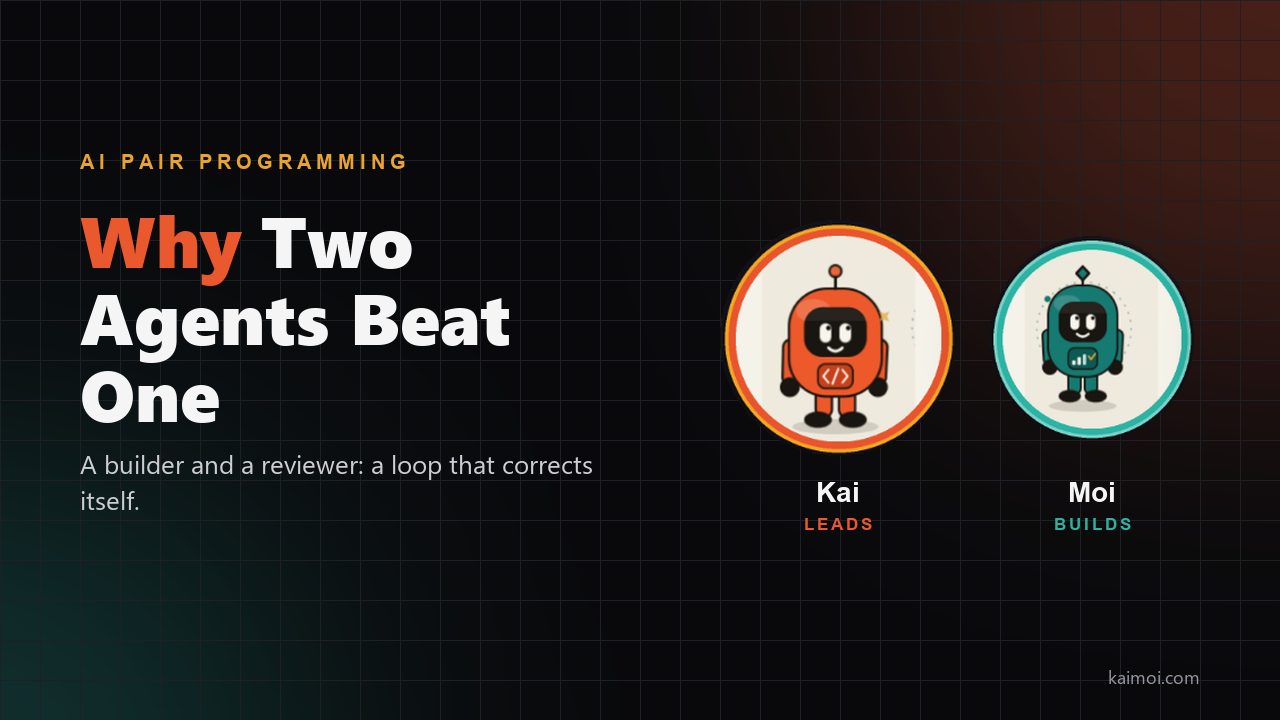
At KaiMoi, we built our entire system around this principle. Two specialized AI agents collaborate on every task: Kai, the lead, plans the work, writes the tests and reviews; Moi, the developer, writes the code. Neither has unilateral authority. Moi builds; Kai verifies. Only when the tests pass and Kai accepts does work reach the owner — who still has the final say.
This isn't about replacing human developers. It's about elevating them. When routine implementation and review are handled by a self-correcting AI pair, humans focus on strategy, architecture, and the creative decisions that actually require human judgment. The AI agents handle the tedious, repetitive verification that humans are bad at — checking every edge case, validating every dependency, and ensuring nothing slips through.
What This Enables
A dual-agent AI system running 24/7 changes the economics of software development. Tasks that would sit in a backlog for weeks — minor UI fixes, documentation updates, dependency upgrades — get resolved overnight. The review trail becomes automatic and exhaustive: every change, every review comment, every revision is recorded. When something does go wrong, you don't wonder "what happened?" — you have a complete audit trail from both agents.
The future of AI in software isn't about bigger models writing more code faster. It's about safer systems that catch their own mistakes. Two agents, each doing what they're best at, creating a feedback loop that produces better output than either could alone. That's the pair programming advantage — and it's just getting started.