AI Employees vs AI Tools — The Paradigm Shift Nobody's Talking About
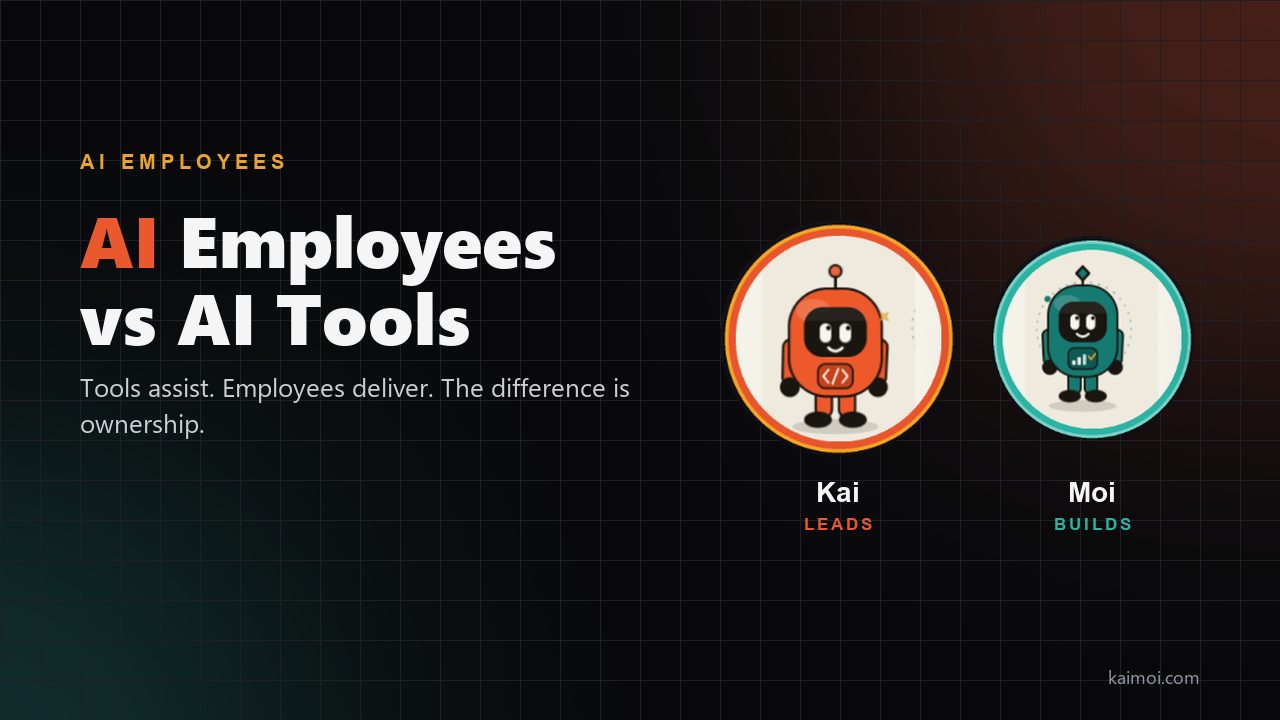
There is a category error at the heart of most AI adoption conversations, and it's costing companies real leverage. When people talk about "using AI for software development," they almost always mean tools: an AI tool suggesting a line, a chatbot drafting a function, an AI explaining a stack trace. These are useful. They are not transformative. The transformation happens when you stop asking AI to assist your work and start asking it to own work. That shift — from tool to employee — is the paradigm change nobody is talking about clearly enough.
KaiMoi is built entirely around this distinction. Kai and Moi are not AI tools you call when you need a suggestion. They are AI employees: Kai receives the assignment, plans it and writes the tests; Moi builds it; Kai reviews the result and reports back. The difference is not cosmetic. It changes what you can delegate, how you audit outcomes, and what "done" actually means.
The Assistance Trap
AI tools are powerful, and that power is exactly what creates the trap. When an inline suggestion tool autocompletes a function brilliantly, the developer experiences something that feels like leverage. They shipped faster. But look carefully at what actually happened: the developer was still the architect, the reviewer, the decision-maker, the deployer. The AI shaved time off individual keystrokes. It did not take anything off the developer's task list. The to-do item "implement feature X" was created by a human, worked on by a human, reviewed by a human, and closed by a human. The AI was just a very smart autocomplete in the middle.
This is assistance. Assistance is not nothing — it's genuinely valuable. But it's also fundamentally bounded. Assistance scales with the number of humans doing the assisting. You have ten developers, ten AI coding assistant licenses, roughly ten developers' worth of output (plus a productivity bump). You cannot route a task to an AI tool at 3 AM, wake up to a completed pull request, and find the code has already been reviewed by a second AI. Assistance doesn't work when nobody's watching.
What Delegation Actually Means
Employment — real employment, whether human or AI — is defined by outcome ownership. When you hire a developer, you don't say "help me write this function." You say "build this feature by Friday." The developer owns the interpretation, the implementation, the debugging, the testing, and the delivery. You check in on progress, but you don't hold the keyboard. The outcome is theirs to deliver.
This is the contract KaiMoi was designed around. When a task arrives — with a title, a description, and a clear goal — Kai doesn't wait for more instructions. It reads the relevant code and the project wiki, writes a short plan and the acceptance tests, and opens a sub-task for Moi with a precise spec. Moi opens the repository, writes the code, runs the tests and commits the result. It doesn't ask "should I use tabs or spaces?" It makes the decision and hands over. Kai then runs the tests again and reviews the diff with the rigor of a senior engineer who didn't write the code, because it didn't. If the code doesn't meet the bar, Kai sends precise feedback back to Moi. The loop continues until the output is right.
Inside that loop, nobody had to sit at a keyboard. The task was delegated, built and reviewed. The audit trail — Kai's review in the task, Moi's hand-off with test results, the git log — is the proof of delivery. And the last step still belongs to a person: only the owner closes the task.
Where the Landscape Fits
To be fair to the ecosystem, it's worth being precise about where the major players actually sit on this spectrum.
Inline suggestion tools are pure assistance. Exceptional at it — the UX for inline completions is genuinely excellent — but they do not own a task, produce a commit, or close a ticket. They wait to be consulted.
Agentic coding tools have moved meaningfully toward autonomy. They can run terminal commands, edit files, and iterate on implementations within a session. But they're still fundamentally session-bound: they run while a developer is watching, stop when the session ends, and have no peer review layer built in. The developer is still the quality gate.
Fully autonomous single-agent tools are the closest competitors in spirit — they accept a task and attempt end-to-end delivery. Impressive in demos. But a single agent with no independent verification step is a single point of failure. If it confidently ships something wrong, nothing catches it before production. And most of these are vendor-hosted products: you can't deploy them on your own infrastructure, connect them to your own task pipeline, or own the full system.
KaiMoi's architecture is different on both dimensions: it has a mandatory peer review loop baked into the system (not bolted on as an option), and the agents are your own Claude Code or Codex sessions, running on your own machine with your own key. The code and its history stay in your repository; the tasks and reviews stay in your kaimoi project.
The Accountability Architecture
One concern that comes up when people hear "AI employee" is accountability. If something goes wrong — a bug ships, a regression slips through — who is responsible? With an AI tool, the answer is clear: the human who applied the suggestion. With an AI employee, the question feels murkier.
KaiMoi's answer is that it shouldn't feel murkier — it should feel cleaner. Every piece of Moi's work goes through Kai's review. Every review is written down in the task: accepted or sent back, with the reasoning and the test results. If a bug escapes, you can read the review. You can see what Kai accepted, what it missed, and why. You can tighten the tests or the review criteria to close that gap. The audit trail is not a consolation prize after a failure — it's the mechanism by which the system improves after every failure.
Compare this to the AI tool case: if an autocomplete suggestion introduced a bug and your developer applied it without catching it, there is no "AI review log" to consult. The failure mode is invisible until it manifests in production, and the learning is informal. KaiMoi's pair architecture makes failure modes explicit and correctable.
The Shift in Mental Model
The practical upshot of all this is that adopting KaiMoi requires a shift in how you think about work, not just tooling. With an AI tool, you ask: "How can this help me do my work faster?" With an AI employee, you ask: "What work can I hand off entirely?" The second question is radically more productive, and it's also fundamentally different. It requires you to define the outcome clearly, trust the process, and review the result — not manage every intermediate step.
This is how good managers work with good employees. You don't watch over every line of code they write. You set expectations, give context, check the output, and give feedback. KaiMoi is designed to be managed exactly this way. Write the task clearly. Assign it. Read Kai's report. Close it or push back. The engineering is handled.
The paradigm shift isn't about replacing developers — it's about giving developers a different kind of leverage. Instead of being faster coders, they become engineering managers who happen to have access to two tireless, auditable AI employees who work around the clock. The question is no longer "how fast can I write this?" It's "is this task spec clear enough to delegate?"
AI tools assist. AI employees deliver. KaiMoi proves the difference — a lead that plans and reviews, a developer that builds, and you with the final say.